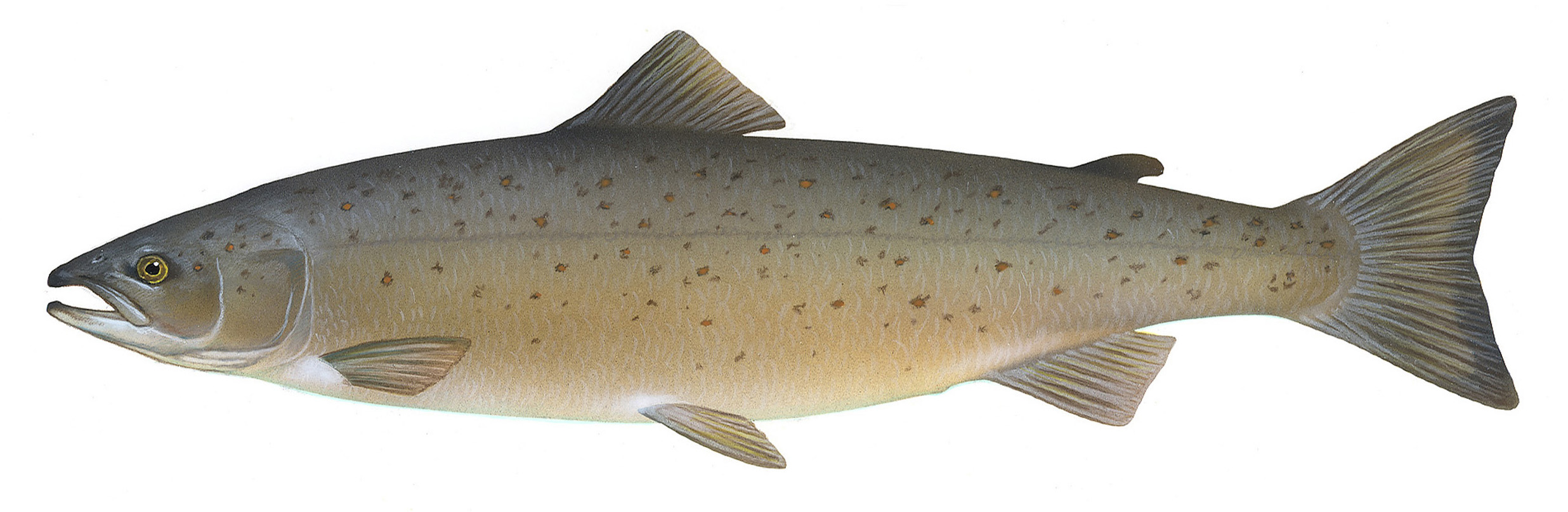
Atlantic salmon (*Salmo salar*).
Creator: Timothy Knepp
Licence: Public domain
View image source
Species record
Atlantic Salmon
Salmo salar
Explore the Atlantic Salmon (Salmo salar) species record in The Ark Is Earth, including classification, habitat, distribution, conservation information, and sources.
Summary
The Atlantic Salmon is an anadromous fish native to rivers and coastal seas of Europe and North America. It hatches in freshwater, grows mainly at sea, and many adults return to their natal rivers to spawn. Salmon carries marine nutrients into freshwater food webs and supports fisheries, while dams, habitat degradation, and other pressures imperil many populations.
Classification in this archive
- Kingdom: Animals
- Phylum: Chordates
- Subphylum: Vertebrates
- Class: Actinopterygii
- Order: Salmoniformes
- Family: Salmonidae
- Genus: Salmo
- Species: Salmo salar
Habitat and distribution
Selected documented locations — not a complete species range.
- Habitat
- rivers, coastal ocean
- Selected regions
- Europe, North America
Conservation status
The Ark records: Near Threatened.
- IUCN Red List — Salmo salar (global Near Threatened assessment, 2023)Accessed 2026-09-25
Did you know?
- Many Atlantic salmon hatch in freshwater, spend part of their lives at sea, and return to rivers to spawn.
- Salmon can carry nutrients from the ocean into freshwater food webs when they return upstream.
More images

Atlantic salmon (*Salmo salar*) in side view.
Creator: Fyn Kynd
Licence: CC BY-SA 4.0
View image source
Sources and attribution
Conservation
IUCN Red List — Salmo salar (global Near Threatened assessment, 2023)Accessed 2026-09-25
General
NOAA Fisheries — Atlantic salmonAccessed 2026-09-16
Images
Wikimedia Commons — Atlantic salmonAccessed 2026-09-16
Images
Wikimedia Commons — Atlantic salmonAccessed 2026-09-16
Images
Wikimedia Commons — File:Atlantic Salmon, Nord-du-Québec, CA-QC, CA imported from iNaturalist photo 404770265.jpgAccessed 2026-09-27
Summary
NOAA Fisheries — Atlantic Salmon Research and Restoration: EcosystemAccessed 2026-09-27